

On 11 February 2020, the Lithuanian Genocide and Resistance Research Centre (LGGRTC) sent me a formal refusal. I had demanded withdrawal of its latest defense of Jonas Noreika. The letter, signed by Director General Teresė Birutė Burauskaitė, did not merely defend the Centre's history. It made a testable statement about German justice: German courts, it said, had exonerated the actual “builders and commanders” of the Šiauliai ghetto and concentration camp.[1]
The German record does not say that.
Hans Gewecke was convicted and sentenced to four years and six months. Ewald Bub's proceeding was discontinued. LGGRTC also said that an Oldenburg court had exonerated Hermann Schleef, but I do not plead the truth or falsity of that third procedural characterization here until the underlying Oldenburg record is independently confirmed.[2]
Conviction and discontinuance are different outcomes. The Schleef claim is a separate verification target.
LGGRTC turned them into one exculpatory story.
The distortion had a purpose beyond improving the postwar biographies of German officials. It was used to protect Jonas Noreika. In its December 2019 memorandum, prepared by Dalius Egidijus Stancikas and signed by Burauskaitė, the Centre used Gewecke's postwar claim that he had not understood that ghettos would end in the destruction of Jews as evidence for the proposition that Noreika likewise did not understand. The same memorandum placed Gewecke inside a rescue narrative: Domas Jasaitis, it said, obtained Gewecke's promise to stop Jewish killings in the Šiauliai region.[3]
The German occupier became a witness for the Lithuanian subordinate.
The alibi traveled down the chain of command.
The man whose memory LGGRTC chose
Hans Ernst-August Friedrich Gewecke was born on 17 July 1906 at Hachenhausen. He was an NSDAP functionary and, from August 1941, Gebietskommissar in Šiauliai under the German civil occupation administration. He died in Heidelberg on 10 March 1991.[4]
By the time LGGRTC elevated his retrospective recollections into evidence in 2019, Gewecke had been dead for twenty-eight years. The way to test his claimed understanding was not to defer to his memory. It was to compare that memory with what he wrote and administered while the destruction was taking place.
His co-defendant, Ewald Bub, was born on 27 October 1912. Schleswig-Holstein's archival index identifies him as a former NSDAP Stabsleiter; LGGRTC itself called him Gewecke's deputy. He served in Gewecke's administrative staff and later appeared with him in the Lübeck proceeding.[5]
These were not peripheral witnesses to the occupation system. They were officials inside it.
March 2019: the Centre chose Gewecke's memory
Gewecke was already inside LGGRTC's 27 March 2019 defense of Noreika. The Centre invoked Claude Lanzmann's filmed interview, held by the United States Holocaust Memorial Museum, and used Gewecke's recollection to support the proposition that people administering ghettos did not necessarily understand that ghettoization would end in extermination. It also compressed his postwar history into Allied detention followed by release.[6]
Two weeks later, Lithuania's presidentially established International Commission for the Evaluation of the Crimes of the Nazi and Soviet Occupation Regimes answered the Centre. Its response identified the documentary issue directly. Noreika's 22 August and 10 September 1941 orders formed part of the administrative process of ghettoization and expropriation in Šiauliai District. The Commission rejected superior orders as an answer to native-collaborator responsibility and rejected the reconstruction of ghettos as temporary safe havens.[7]
The same response stated that later anti-Nazi activity did not erase earlier anti-Jewish administrative conduct. It also noted that there is no record of a ranking Lithuanian official being executed or imprisoned for refusing anti-Jewish German directives during the height of the genocide.[8]
Christoph Dieckmann and Joachim Tauber were among the historians listed behind that response. That matters because both had reconstructed the German occupation record from the archives. The Centre had used Gewecke's late memory. Two historians who knew the contemporaneous German paperwork had now participated in a written state-level rejection of the Centre's reading.
LGGRTC had notice by April 2019.
It did not withdraw the proposition.
It enlarged it.
December 2019: the German administrator became an alibi
The 17 December memorandum acknowledged that Gewecke was one of the initiators and organizers of the Žagarė and Šiauliai ghettos. It then placed his retrospective claim of ignorance beside Noreika's asserted ignorance. If the German Gebietskommissar who helped create the ghettos supposedly did not know what ghettoization meant, the Lithuanian district chief implementing the directives could be placed still farther from genocidal knowledge.[9]
The Centre's evidentiary stack is revealing. In February 2020, when challenged, it said the “did not understand” conclusion rested not only on its readings of a Stahlecker passage and an NKVD-era statement by Ignas Urbaitis, but also on conclusions attributed to Vilnius ghetto researcher Ilja Lempert, Gewecke's filmed memoirs, and the supposed German judicial exonerations of Gewecke, Bub, and Schleef.[10]
That is an arrangement, not merely a bibliography.
The December memorandum then moved from historical psychology to legal history. It said a Lübeck court in 1969 had rejected Holocaust accusations against Gewecke and “Evaldas Bubas,” described Bub as completely acquitted, and reduced Gewecke's punishment to the hanging of B. Mazoveckis. That is LGGRTC's identification. Curilla anonymizes the victim as “M.”, and I follow Curilla's form below rather than adopt the name independently.[11]
The Centre did not cite the German judgment. It cited the commercial Lithuanian news portal TV3.[12]
The memorandum’s own citation led to a TV3 feature published on 21 May 2011, more than eight years before the Centre used it as its source for the German court outcome.
By then the judgment had long been published in Justiz und NS-Verbrechen as Lfd. Nr. 722. Its editor, Dr. D. W. de Mildt, has now confirmed that case identification directly. A state archival research institution could have cited the published German judgment. It cited a Lithuanian television website instead.[13]
The date was wrong as a description of the judgment. The trial opened in 1969; judgment was delivered on 27 January 1970. The categories were worse. Gewecke was convicted. Bub's proceeding was discontinued. “Completely acquitted” is not what the German case index says.[14]
On 11 February 2020, after a formal demand for withdrawal, Burauskaitė's refusal defended the Centre's March and December findings as an integrated body of research. It invoked Gewecke again, Bub again, and Schleef. Then it generalized its descriptions of the three proceedings into the proposition that German courts had exonerated the actual builders and commanders.[15]
This came after the International Commission's warning and after the Centre had been asked to correct the record. For the broader pattern of Burauskaitė's post-notice defenses, see her documented record.
The paper trail from Gewecke to Noreika
Planning for the concentration of Jews in Šiauliai predated Gewecke's assumption of full civil administration. The surviving administrative chain after his arrival is nevertheless unusually concrete.
On 13 August 1941, Gewecke met Lithuanian district chiefs and mayors and instructed them to establish ghettos. Dieckmann distinguishes a written ghettoization order of the Gebietskommissar dated 14 August from a separate 14 August communication to district chiefs and mayors concerning Gewecke's instructions and directives of the previous day.[16]
That second document is in LCVA R 1099-1-1, leaves 153-155. In the same archival file, Noreika's Order No. 962 of 22 August is at leaf 156.[17]
The archival sequence does not require speculation about an oral chain reconstructed decades later. A German administrative communication concerning Gewecke's instructions occupies leaves 153-155. Noreika's surviving order follows at 156.
The surviving Noreika order refers to the Šiauliai District Commissioner by office. Lithuania's International Commission identifies that official as Gewecke. The distinction should be preserved: the order does not need to print Gewecke's personal name for the administrative chain to be identifiable.[18]
LGGRTC used the German administrator to make the Lithuanian subordinate look less knowing. The archive instead supplies the German administrator as the contemporaneous source against which both men's claimed understanding has to be tested.
What Gewecke wrote while the killing was underway
On 10 September 1941, Gewecke sent a report to the General Commissioner in Kaunas. Dieckmann and Tauber both use it. Tauber gives the primary locator, Bundesarchiv R 90/146.[19]
Gewecke reported that the districts under his administration had been heavily populated by Jews when civil administration began and were now almost entirely judenfrei, free of Jews. In Šiauliai, about 6,000 Jews had been concentrated. After what he called Verschickungsaktionen, “shipping actions,” about 5,000 remained. Tauber reads the wording as a thinly veiled report of the murder of approximately 1,000 Jews.[20]
Gewecke expected about 4,000 Jews, including family members, to remain because the economy still depended on Jewish specialists. Lithuanian district chiefs and mayors had been instructed to put young Lithuanians beside those specialists to learn their work.
The purpose was explicit. The replacements were being trained so that, “at the appropriate time,” the Jewish problem could be solved completely without damage to the economy. Gewecke assured his superior that the matter was being handled with the necessary intensity and National Socialist harshness.[21]
The postwar proposition was that he did not understand where ghettos led.
The wartime document describes districts becoming free of Jews, a ghetto population falling after “shipping actions,” temporary retention of indispensable workers, replacement training, and a future complete solution once the economy no longer needed them.
LGGRTC knew how to cite Gewecke's memory.
It gave his 10 September report no comparable narrative force.
Rescue with an expiry condition
The strongest evidence favorable to Gewecke belongs in the record without qualification games. Wolfgang Curilla, reporting the Lübeck judgment and mapping his propositions to the judgment's internal pages, says Gewecke, with Reichskommissar Lohse's backing, prevented the commander of EK 3, Jäger, from carrying out a proposed partial liquidation of the Šiauliai ghetto.[22]
That happened. It matters.
Curilla files the discussion in Part Three of his monograph, Die Täter, “The Perpetrators,” section 49, “Andere Institutionen.” The placement does not decide every question about Gewecke, but it prevents a rescue intervention from being detached from the administrative system in which Curilla analyzes it.[23]
The same judgment, as Curilla reports it, explains why the ghetto was being preserved. Jewish labor remained economically valuable. Lohse fixed ghetto rations at half the allocation for the Lithuanian population. Jews were forbidden to acquire extra food to combat the resulting hunger and bring it back into the ghetto.[24]
Gewecke later turned selective restraint into a rescue biography. Uwe Danker records him claiming that he had preserved roughly 5,000 Jews from the SD, fought for their lives, and repeatedly outwitted the security apparatus.[25]
LGGRTC supplied a Lithuanian bridge. Its December memorandum said Domas Jasaitis obtained a promise from Gewecke to stop Jewish killings in the Šiauliai region and placed that episode inside its rescue architecture for Noreika.[26]
There is no reason to suppress a rescue, a successful intervention, or a temporary restraint on killing. The problem begins when one event is made to answer a different question.
Preventing one liquidation does not establish ignorance of the exterminatory process. Negotiating with a rescuer does not erase anti-Jewish orders. Preserving skilled workers because the economy needs them does not become evidence that the administrator did not understand why the rest were disappearing.
In the Bobelis record, rescue was turned into character evidence. In the Gewecke record, rescue is turned into knowledge evidence. The favorable exception is made to prove that the administrator did not understand the system he was administering.
The witness LGGRTC chose
Gewecke's retrospective vocabulary existed long before Claude Lanzmann filmed him. Danker records a 24 January 1958 interrogation in which Gewecke described his office as concerned with the “proper” confiscation and registration of Jewish property, with property properly listed and sent onward to the Reich.[27]
The separation is familiar: ghettoization, confiscation, registration, rations, labor, and policing become administration. Killing becomes the responsibility of somebody standing elsewhere.
Twenty-one years later, Lanzmann filmed Gewecke in Mölln with a hidden camera under the false name “Dr. Sorel.” The USHMM catalog identifies the interview as Accession 1996.166, RG-60.5027, Film IDs 3298-3313.[28]
This is the interview LGGRTC itself selected as evidence.
On Roll 2B, Gewecke describes his duties as including ghettoization. On Roll 9B, he acknowledges that conditions were inhuman, that rations were half the Lithuanian allocation, and that people may have starved. On Roll 10B, the interview turns to property seizure, restrictions including the pregnancy prohibition, and threats tied to food smuggling.[29]
The Lübeck judgment, as reported by Curilla, independently matches the ration point: half-rations, hunger, and a prohibition on supplementary food.[30]
On Roll 4B, Gewecke invokes David Hoggan's The Forced War while discussing the claim that international Jewry had declared war on Hitler. The Museum catalog identifies Hoggan as a Holocaust denier.[31]
The Centre chose USHMM as the custodian of its evidence. The same repository it invoked supplied the roll-level admissions about ghettoization and hunger and flagged the source Gewecke used for the “international Jewry” claim.
At the 1958 Ulm proceedings involving Einsatzkommando Tilsit, Gewecke was asked about testimony concerning a 1941 meeting at Kretinga where the killing of women and children and Lithuanian participation were discussed and at which a representative of the Gebietskommissariat had been present. Jokimaitis reports that Gewecke invoked his right to silence when questioned about it. He later said he regretted having done so and attributed the silence to his mental state after recently leaving prison; according to Jokimaitis, investigators did not repeat the question.[32]
None of these items, alone, proves what Gewecke knew on every date.
Together they make it impossible to treat his late retrospective claim of innocent misunderstanding as self-authenticating historical evidence.
Cigarettes, bread, sausage, chocolate, and a gallows
Curilla's pages are unusually valuable because footnotes 570 through 580 repeatedly cite “LG Lübeck gegen Gewecke” by the judgment's internal pages: 11, 15/16, 16, 17, 18, 19, 20, 21, 21/22, 32, 34, 22, and 52. He gives a retrieval map into the judgment itself. Those pages are now identifiable retrieval targets; LGGRTC's 2019 memorandum cited neither the judgment nor this scholarly page map.[33]
The judgment, as Curilla reports it, says the Gebietskommissariat established the two fenced Šiauliai ghetto districts, Traku and Kaukasus, guarded by Lithuanian police. Jews returning from outside work were searched with the assistance of the German gendarmerie and Lithuanian police.[34]
At the end of May 1943, a Jewish baker, identified by Curilla as M., was returning toward the Kaukasus ghetto with about thirty packs of cigarettes plus bread, sausage, and chocolate. He fled into a bakery yard. Lithuanian policemen apprehended him. A member of the Gebietskommissariat ordered his arrest.[35]
Repeated attempts by the Judenrat and M.'s relatives to obtain clemency were rejected by Gewecke. On 6 June 1943, M. was hanged on the order of the Gebietskommissariat. Curilla reports that two Jews selected by the Judenrat carried out the hanging; that does not conflict with separate evidence that ghetto craftsmen built the gallows, and the two facts should not be merged.[36]
The German judgment that LGGRTC later invoked as exculpatory history therefore contained findings of Lithuanian police guarding both ghetto districts, searching returning Jewish workers, and making the arrest that led to the hanging. The Centre reached into a German judgment for a proposition about German responsibility and did not report the Lithuanian findings inside the same record.
Curilla reports the judgment's treatment of an anonymized “Abteilungsleiter B.” at internal pages 22 and 52. B. led the execution for the Gebietskommissariat, repelled the prisoner's sister-in-law with a movement of his foot when she brought the mother's clemency petition, and ordered the Judenrat to leave the corpse hanging until midday and restrict the burial.[37]
The co-defendant in the Lübeck proceeding was Ewald Bub. Until the full judgment is in hand, I do not silently replace Curilla's anonymized “B.” with Bub's full name inside a quotation. The German record already provides enough without pretending to possess a page I have not yet seen.
The trial opened on 5 May 1969. The Landgericht Lübeck delivered judgment on 27 January 1970. Gewecke received four years and six months. Justiz und NS-Verbrechen records Bub's proceeding as “Verfahren eingestellt”, proceedings discontinued.[38]
The Bundesarchiv finding aid independently confirms that B 162/14394 contains the Lübeck judgment together with BGH 5 StR 631/70, dated 26 January 1971.[39]
The same finding aid tags both the 17 August 1965 indictment and the 27 January 1970 judgment with “SA 354”; its abbreviation list defines “(A)SA” as “(Anklagen-)Sammelakte,” a collective indictment file. The German archive therefore catalogues the indictment and judgment under the same collective-file identifier.
A public dejure reproduction exposes an excerpt from the appellate decision. It recounts trial findings that Gewecke wanted the killing to occur, could have withdrawn the order, actively furthered the act by sending B. to the execution, and knowingly and intentionally allowed the killing to proceed.[40]
German reference sources characterize Gewecke's conviction as Beihilfe zum Totschlag, accessory to manslaughter. The BGH excerpt recounts trial findings about a killing committed by a subordinate and Gewecke's role in furthering and knowingly allowing it. Those are different source descriptions. I preserve both without attempting to reconcile them as a matter of German criminal-law doctrine, and I do not rewrite Gewecke as the principal perpetrator.[41]
LGGRTC's December memorandum converted this record into a 1969 court that had rejected Holocaust accusations, a completely acquitted Bub, and a residual punishment for one hanging.
The published record is not exculpatory shorthand.
It is a conviction and a discontinued proceeding.
Bub was “wholly exonerated” and “refinedly brutal” in the same sentence
Dr. de Mildt confirmed to me on 31 August 2026 that Lfd. Nr. 722 is the Gewecke/Bub case and supplied two contemporary German press clippings.[42]
The 28 January 1970 report states that proceedings against Bub were discontinued. It says the original allegation of complicity in murder was not established, but also reports that a possible accessory-to-manslaughter proceeding was not brought because the limitation period had expired.[43]
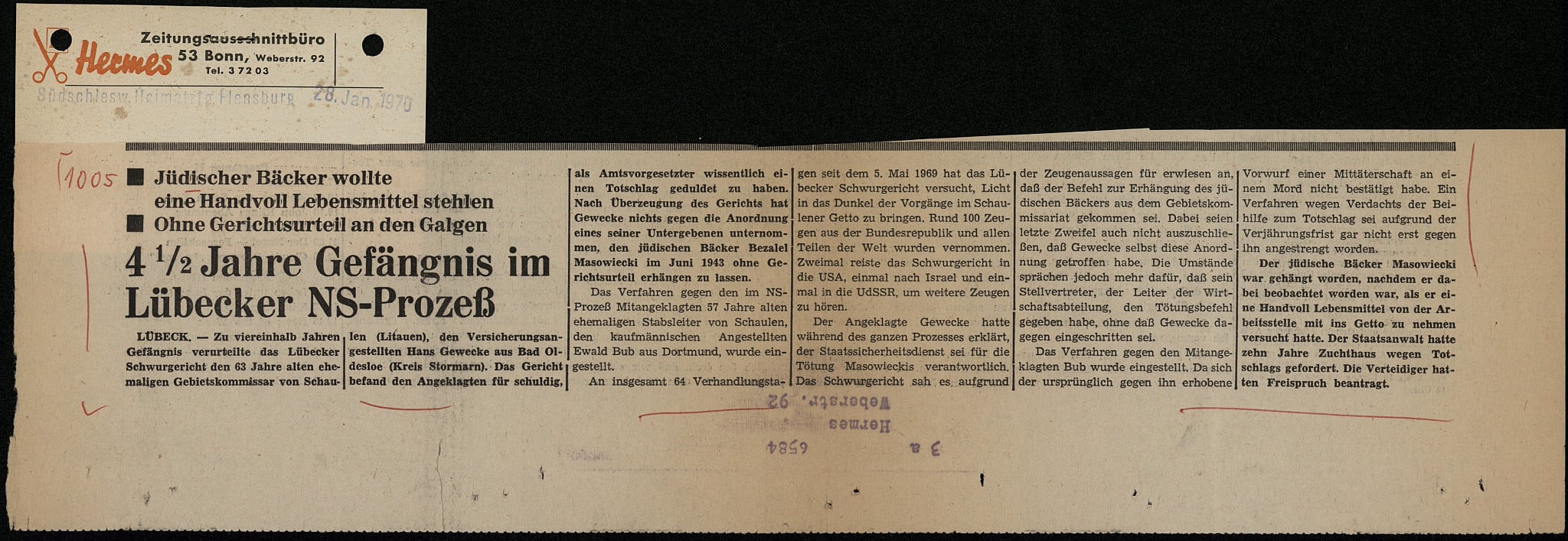
That is not “wholly exonerated.”
A limitation bar is not a factual finding that conduct did not occur. A discontinuance is not an acquittal. Failure to establish one legal theory is not an affirmative judicial declaration of historical innocence.
The surviving descriptions also leave an unresolved legal asymmetry. German reference sources characterize Gewecke's conviction as accessory to manslaughter, while the contemporary report says a possible accessory-to-manslaughter proceeding against Bub was not brought because limitation had expired. I do not resolve that difference here. The exact procedural reason one theory remained available against Gewecke and not against Bub must be established from the judgment and prosecutorial files, not supplied by inference.[44]
LGGRTC's own February 2020 refusal contains a still cleaner contradiction. In the same sentence, it calls Bub “wholly exonerated” while reproducing Domas Jasaitis's description of him as “refinedly brutal” and responsible for Noreika's March 1943 arrest and deportation to Stutthof.[45]
The Centre wanted Bub in two incompatible narrative roles at once. His brutality was useful when it certified Noreika's anti-Nazi credentials. His “exoneration” was useful when it certified the Centre's claim that German courts had cleared the men responsible for the ghetto.
The same sentence supplied both.
That contradiction does not require a newly discovered German file. It is in LGGRTC's own refusal.
Schleef: a claim reserved pending primary confirmation
LGGRTC's 11 February 2020 refusal also said that the Oldenburg Regional Court had exonerated Hermann Schleef on 27 April 1970. That assertion remains material, but this revision does not plead its falsity without the primary Oldenburg record.
A 2021 newspaper report by Hans Begerow appears to point to Oldenburg archival files bearing on the claim. I do not presently have a stable copy of that report or the underlying records. On 2 September 2026, I asked the Niedersächsisches Landesarchiv, Abteilung Oldenburg, for direct confirmation. Until that confirmation is in hand, I do not use the report to establish Schleef's procedural disposition, the reported 5 November 1943 selection figure, the Seimas/embassy transmission history, or the denazification and Spruchkammer details.[46]
Accordingly, the Schleef proposition is reserved, not pleaded. The article's case against LGGRTC does not depend on it.
A partial discontinuance preceded the indictment
The broader German Gewecke/Bub proceeding is now mapped much more precisely than it was when LGGRTC wrote its memoranda.
The Bundesarchiv B 162 finding aid identifies the central investigation as AR-Z 774/61, “Tötungsverbrechen an der jüdischen Bevölkerung im Gebietskreis Schaulen (Litauen) in den Jahren 1941 bis 1944,” killing crimes against the Jewish population in the Gebietskreis Schaulen from 1941 to 1944.[47]
The same finding aid identifies B 162/4368 as a Teileinstellungsverfügung, a partial-discontinuance order, of Staatsanwaltschaft Lübeck 2 Js 297/60, dated 4 August 1964. It identifies B 162/4363 as containing the indictment in that same prosecutor's file against Gewecke and Bub, dated 17 August 1965. And it identifies B 162/14394 as containing the 1970 judgment and the 1971 BGH decision.[48]
The chronology can be stated without guessing what the unseen 1964 order says: a partial discontinuance occurred in August 1964; the same prosecutorial file continued to an indictment a year later; the trial opened in 1969; judgment followed in 1970.
Whatever file 4368 disposed of, it did not end the entire case.
What I will not do is infer from the archival title which allegations, defendants, factual complexes, or legal theories were discontinued. That requires reading the order itself.
USHMM has confirmed that its copy, RG-14.101, is digitized but onsite-only. File 4361 is on reel 521; files 4362-4368 are on reel 522; file 14394 is on reel 28. A proxy researcher may reproduce the documents in the Museum's reading room.[49]
The document exists. Its location, prosecutor's file number, type, and date are known. Its substantive scope remains open until it is read.
The present case against LGGRTC does not depend on filling that gap with speculation. The Centre's treatment of Gewecke's conviction and Bub's discontinued proceeding is already testable. The Schleef claim is not needed for that case and is reserved pending primary confirmation.
If the partial-discontinuance order later changes a material proposition, I will publish the change.
The strongest defense of Gewecke still does not rescue LGGRTC
A fair record includes the favorable evidence.
Curilla's page map says Gewecke blocked Jäger's proposed partial liquidation with Lohse's support. Jewish witnesses gave evidence favorable to him. Jasaitis remembered a German official with whom some accommodations could be negotiated. The court treated Gewecke's conduct in preserving the ghetto at that moment as mitigation.[50]
The German investigation also contains evidence favorable to Noreika. Jokimaitis reports that none of the 123 witnesses appears to have named Noreika. When investigators asked Gewecke about him, Gewecke remembered Noreika as an opponent of German leadership who later sabotaged instructions and was arrested. He described their relations as close.[51]
Those facts should be printed, not hidden.
They do not perform the work LGGRTC assigned to them.
Noreika's later anti-German activity does not erase his signed 1941 administrative acts. Lithuania's International Commission made exactly that distinction in April 2019. Later Nazi persecution of Lithuanian anti-Nazi activists was not a defense to earlier participation in anti-Jewish measures.[52]
Selective restraint can coexist with persecution. Later resistance can coexist with earlier collaboration. An administrator can preserve indispensable workers and still administer a coercive ghetto system. A court can credit mitigation and still convict.
The Centre needed the favorable side of the chronology to cancel the adverse side.
Historical method requires both.
West German procedure was not a certificate of innocence
The Gewecke investigation was not trivial. Jokimaitis reports 123 witnesses, most of them Jewish survivors: 41 interviewed in the United States, 6 in Canada, 20 in Israel, others elsewhere, together with documentary material obtained internationally.[53]
Whatever one thinks of the eventual dispositions, the file cannot be described as a cursory or thin inquiry. The size and geographic reach of the investigation make it especially important not to convert later evidentiary or procedural outcomes into findings that the underlying events did not occur.
West German Nazi-crime prosecutions also failed for legal reasons that cannot be translated into historical innocence. Danker explains how the 1968 criminal-law reform affected accessory cases: proof tied to the individual defendant's adoption of the principal perpetrators' base motives became critical to murder liability, while other homicide conduct could fall toward manslaughter and encounter limitation barriers.[54]
The contemporary Bub report illustrates the point. It did not say a court found Bub historically innocent. It reported one allegation unestablished and a possible lesser homicide theory barred by limitation.[55]
Jokimaitis reports a third Šiauliai non-prosecution from the same investigative universe. After the Gewecke case, prosecutors continued for seven more years to investigate SS-Hauptscharführer Julius Hungerberg of Einsatzkommando 2, gathering witness and documentary material. They ultimately did not send the case to court for lack of evidence.[56]
Taken together, the broader record is not a sequence of acquittals. The Gewecke/Bub file contains a 1964 partial discontinuance of still-unknown scope; Bub's proceeding was discontinued; Hungerberg was dropped after seven additional years. Those non-trial outcomes sit beside an investigative record that, in the Gewecke case alone, reached 123 witnesses across three continents. They mark evidentiary and procedural endpoints under West German law, not findings that the underlying events did not occur.
The categories remain different: conviction, discontinuance, limitation, and non-prosecution for insufficient evidence are not interchangeable historical verdicts.
Franz Murer: an acquittal is not a historian's certificate
Curilla's next paragraph supplies a useful warning. He notes that Franz Murer, an official of the Vilnius Gebietskommissariat, was accused by numerous survivors of killing individual Jews and was acquitted on all counts at Graz. Curilla then cites scholarship by Rabinovici sharply criticizing that acquittal as a manifest miscarriage of justice.[57]
An acquittal is a real legal category and must be described accurately. It still does not require historians to pretend that a criminal verdict exhausts the historical evidence.
A criminal case answers the legal questions before that tribunal under the law, evidence, burdens, and procedural constraints governing that case.
LGGRTC made foreign procedural outcomes perform a different function: moral certificates for the administrative system.
The same institutional method appears elsewhere
The Gewecke file does not stand alone.
In “Lithuania Invented a U.S. Exoneration”, I published the original American record behind Lithuania's claim that Juozas Ambrazevičius-Brazaitis was “rehabilitated” or exonerated by the United States Department of Justice. The INS record says the investigation was deactivated, not that a court or the Justice Department adjudicated historical innocence, and it expressly contemplated reactivation if meaningful evidence later emerged.
Here the Centre converts proceedings discontinued into wholly exonerated and a conviction into an exculpatory narrative about rejected Holocaust accusations. Its separate Schleef “court exoneration” claim is reserved in this article pending primary confirmation from Oldenburg.
The recurring method is the conversion of procedural language into moral innocence.
Foreign records make the test unusually simple. What did the German or American document actually say? What did the Lithuanian state institution later say it said?
How the arrangement produces innocence
The mechanism can be stated concretely.
First, the Centre accepted the retrospective memory of a Nazi administrator as evidence of innocent understanding while treating Noreika's signed, archivally located administrative orders as insufficient to carry comparable evidentiary weight. Gewecke's recollection became evidence about what administrators could know. Noreika's signed orders were surrounded with demands for additional proof of subjective murderous purpose.
Second, the Centre gave Gewecke's rescue intervention a narrative and gave his 10 September 1941 wartime report almost none. The favorable episode acquired motive, agency, and explanatory force. The contemporaneous report about a declining Jewish population, indispensable specialists, Lithuanian replacements, and a future complete solution did not.
Third, the rescue story had named agents; the killing story lost them. Jasaitis negotiated. Gewecke promised. Noreika was linked to resistance. When the Jews disappeared, agency migrated toward the SD, Gestapo, “German government,” or abstract liquidation. The administrative system through which people were concentrated, guarded, starved, searched, dispossessed, and transferred toward death was broken into pieces.
Fourth, a state archival research institution cited TV3 for a German judgment that had been published in a specialist German case collection. The choice matters because the Lithuanian retelling supplied the very category changes the German record corrects.
Fifth, the Centre used the German legal record selectively. Gewecke's intervention against one liquidation was preserved. His conviction was narrowed. Bub's discontinuance became “wholly exonerated.” The German judgment LGGRTC invoked as exculpatory contained findings, as reported by Curilla, that Lithuanian police guarded both ghetto districts, searched returning Jewish workers, and apprehended the prisoner whose case ended at the gallows. The Centre reached into that judgment for a proposition about German responsibility and did not report the Lithuanian findings inside the same record.[58]
Sixth, the text itself carries evidence of source distance. The Centre used the Lithuanianized “Evaldas Bubas” for the German defendant Ewald Bub. That spelling proves nothing by itself. Beside the TV3 citation and the failure to cite the published German judgment, it is a textual clue consistent with dependence on Lithuanian secondary retellings rather than direct engagement with the German case record.[59]
A state institution that assigns narrative force to favorable fragments while fragmenting, downgrading, or changing the category of adverse evidence is producing propaganda.
Calling the mechanism propaganda is not a substitute for evidence.
The arrangement of the evidence is the evidence.
What the record permits us to charge
Against Hans Gewecke, the record permits a differentiated finding. He administered ghettoization and anti-Jewish coercive measures; his wartime report contemplated a future complete solution after Jewish labor had been replaced; he also intervened to prevent at least one proposed liquidation and received mitigation for that conduct; and a German court convicted him as an accessory in the hanging of a Jewish ghetto prisoner.[60]
Against Ewald Bub, the published German record permits no statement of “complete acquittal.” JuNSV records the proceeding as discontinued. A contemporary account reports a limitation problem concerning a possible lesser homicide theory. LGGRTC's own refusal simultaneously called him “wholly exonerated” and “refinedly brutal.”[61]
Against Hermann Schleef, I reserve the procedural characterization pending primary confirmation from the Oldenburg archive. LGGRTC's claimed 1970 court exoneration remains a verification target, not a pleaded count in this article.
Against Jonas Noreika, this article does not need Gewecke to establish the signed 1941 administrative record. The point is narrower: LGGRTC used Gewecke's retrospective defense and supposed German exonerations to manufacture distance between Noreika's administrative acts and the exterminatory system those acts served. The documentary chain around Žagarė and Order No. 962 exists independently of Gewecke's postwar self-description.
Against LGGRTC, the evidence supports a charge of post-notice exculpatory distortion and institutional historical dishonesty. I am not a lawyer, and I am not alleging a legally adjudicated fraud offense. The documentary judgment here is historical: the Centre changed procedural categories, privileged the occupier's retrospective self-defense over his wartime administrative language, converted selective rescue into evidence of ignorance, and persisted after authoritative notice. It had been warned in April 2019, repeated the framework in December, and formally defended it after challenge in February 2020.
Against Lithuania, the charge is institutional, not ethnic. It concerns a state-funded historical body and responsible officials. It is not an accusation against Lithuanians collectively. Lithuanian rescuers, victims, perpetrators, dissenters, historians, and present-day institutions must remain distinct.
Source rule
Based on the record I have documented over decades, I do not regard the Lithuanian Genocide and Resistance Research Centre (LGGRTC) as a presumptively reliable historical authority. In my assessment, its publications have repeatedly functioned as instruments of national historical advocacy and, in material instances, as vehicles for distorted or fictionalized history.
Accordingly, I assign no independent evidentiary weight to a historical claim merely because it has been published by the Lithuanian Genocide and Resistance Research Centre. Any material proposition originating with the LGGRTC must be independently verified against primary documentation or credible external historical scholarship before it is relied upon. Until such verification is obtained, the LGGRTC's assertion is treated as unverified and presumptively unreliable, with particular scrutiny for omission, selective quotation, exculpatory reframing, or factual distortion.
Verdict
The German record restores the categories.
Gewecke was convicted and sentenced to four and a half years. Bub's proceeding was discontinued. LGGRTC's separate claim that an Oldenburg court exonerated Schleef remains reserved pending primary confirmation and is not used as a basis for this verdict. A separate partial-discontinuance order in the broader Gewecke/Bub prosecutor's file has been located. It predates the indictment by a year. Its substantive scope has not yet been read, and I make no claim about what it disposed of.[62]
The wartime Gewecke reported districts becoming free of Jews, a declining ghetto population, indispensable Jewish specialists, Lithuanian replacement trainees, and a future complete solution of the Jewish problem. The postwar Gewecke separated administration from annihilation and recast selective restraint as rescue. The interview LGGRTC chose preserved admissions about ghettoization, half-rations, possible starvation, confiscation, and coercive controls. Curilla's page map of the Lübeck judgment preserves both the favorable finding that Gewecke blocked one proposed liquidation and the coercive record culminating in the June 1943 hanging.[63]
A competent historical institution could print all of that and argue over weight.
It could not honestly turn convicted into an exculpatory judicial story or proceedings discontinued into wholly exonerated. The separate Schleef claim remains outside this verdict pending primary confirmation.
LGGRTC was warned before it repeated the method.
Hans Gewecke built an alibi for himself.
Lithuania inherited it for Jonas Noreika.
Appendix: research status and outstanding sources
This appendix applies a stricter rule than the record it criticizes: when a located source has not been read, I say so and do not infer its contents. The items below are disclosed as outstanding research, not silently filled gaps. None of them carries the article’s core accusation; if later primary material materially supplements, contradicts, or narrows a proposition stated here, I will publish that change.[64]
1. B 162/4368, 4 August 1964. The Bundesarchiv finding aid identifies a Teileinstellungsverfügung of Staatsanwaltschaft Lübeck, 2 Js 297/60, within AR-Z 774/61. USHMM holds the digitized copy in RG-14.101, reel 522, but it is onsite-only. The order itself has not yet been read. I still seek its exact allegations, defendants, legal theories, and reasons for partial discontinuance.
2. B 162/4363, 17 August 1965. The same finding aid says this volume contains the indictment against Hans Gewecke and Ewald Bub in 2 Js 297/60. It has not yet been examined in full. It is needed to identify precisely what survived the 1964 partial discontinuance and proceeded toward trial.
3. B 162/14394. The finding aid identifies the Landgericht Lübeck judgment, 2 Ks 1/68, of 27 January 1970 and says the file also contains BGH 5 StR 631/70 of 26 January 1971. The dejure appellate page has been opened and verified, and a dated local research capture has been retained. The underlying judgment and appellate file have not yet been examined in full.
4. Web preservation. The current TV3 page cited by LGGRTC and the current dejure page were both re-opened and verified on 2 September 2026, and dated local captures are retained. Third-party timestamped archive snapshots remain outstanding. This is a preservation task, not a substitute for the German record: the Gewecke/Bub case identification and disposition are independently tied to Justiz und NS-Verbrechen, Dr. de Mildt's confirmation, the Bundesarchiv finding aid, the BGH record, and the contemporary clipping.
5. The full AR-Z 774/61 sequence. USHMM states that file 4361 is on RG-14.101 reel 521, files 4362-4368 are on reel 522, and file 14394 is on reel 28. The Ludwigsburg material alone approaches 2,000 pages and is digitized but available only onsite. A Museum visit or proxy researcher is still required.
6. Ewald Bub's formal procedural record. JuNSV records Verfahren eingestellt, and the contemporary 28 January 1970 report describes both an unestablished murder-complicity allegation and a limitation bar affecting a possible accessory-to-manslaughter theory. The surviving descriptions leave an unresolved asymmetry with Gewecke’s accessory-to-manslaughter conviction. The underlying judgment and prosecutorial files are still needed to explain that difference rather than guess at it.
7. Schleef primary verification. The exact Begerow article is known: Hans Begerow, “Auf Spurensuche zum Holocaust: Auf den Spuren von SS-Mann Schleef aus Delmenhorst,” Nordwest-Zeitung, 10 May 2021. A stable direct article URL and preserved copy have not yet been obtained. In this revision it is retained only as a lead and carries no substantive allegation. On 2 September 2026, I asked the Niedersächsisches Landesarchiv, Abteilung Oldenburg, for direct confirmation of LGGRTC's claimed 27 April 1970 court exoneration and of the reported investigation/discontinuance records. Until primary confirmation is obtained, the article does not plead the reported no-indictment/no-judgment disposition, the 796 figure, the Seimas/embassy transmission history, or the denazification and Spruchkammer details.
8. Julius Hungerberg. The seven-year post-Gewecke investigation and its non-prosecution for insufficient evidence are currently reported through Jokimaitis. The underlying German disposition has not yet been retrieved.
Continuing work beyond the premises of this article includes USHMM RG-26.004, the onsite-only Lithuanian KGB war-crimes investigation and trial records for the Šiauliai region. Those materials may supplement the larger research record, but this article does not depend on them.
[1] Lithuanian Genocide and Resistance Research Centre (LGGRTC), response of 11 February 2020, signed by Director General Teresė Birutė Burauskaitė. The final pages state that German courts had exonerated the actual “builders and commanders” of the Šiauliai ghetto and camp. Public English copy: https://static-cdn.toi-media.com/blogs/uploads/2026/05/Atsakymas-Gochinui-i-01-16_en.pdf.
[2] For Gewecke and Bub: Justiz und NS-Verbrechen, Lfd. Nr. 722, LG Lübeck, 27 January 1970, 2 Ks 1/68; the case index records Gewecke at 4½ years and Bub as “Verfahren eingestellt.” The article treats LGGRTC's separate Hermann Schleef proposition as an unresolved verification target pending primary confirmation from Oldenburg and does not rely on the Begerow report to establish Schleef's procedural disposition.
[3] LGGRTC, “Memorandum on Jonas Noreika (General Storm) Activity in Anti-Nazi Underground,” 17 December 2019, prepared by Dalius Egidijus Stancikas and signed by Director General Teresė Birutė Burauskaitė. The memorandum attributes to Domas Jasaitis the claim that his efforts obtained from Gewecke a promise to stop Jewish killings in the Šiauliai region. Public English copy: https://static-cdn.toi-media.com/blogs/uploads/2026/05/Annex-No-46-GRRCL-2019-December-memorandum-second-memorandum-on-Jonas-Noreika.pdf.
[4] Gedenkorte Europa, “Hans Gewecke (1906–1991),” giving birth 17 July 1906 at Hachenhausen, service as Gebietskommissar in Šiauliai, and death 10 March 1991 at Heidelberg: https://www.gedenkorte-europa.eu/de_de/article-hans-gewecke-1906-ndash-1991.html.
[5] Landesarchiv Schleswig-Holstein (LASH), Abt. 786, Nr. 2402, Berichtsakte concerning Hans Gewecke and Ewald Bub, LG Lübeck Az. 2 Ks 1/68, Laufzeit 1957–1971, Organisations- und Aktenzeichen VIII 411E-77/57. The item identifies Gewecke (born 17 July 1906) and Bub (born 27 October 1912), the latter as former NSDAP Stabsleiter; LGGRTC’s February 2020 English response calls Bub Gewecke’s deputy.
[6] LGGRTC statement of 27 March 2019, reproduced in English by the Lithuanian Jewish Community, including reliance on Hans Gewecke’s filmed recollections and the compressed account of Allied detention and release: https://www.lzb.lt/en/2019/03/28/who-sanctioned-institutional-anti-semitism-in-lithuania/.
[7] International Commission for the Evaluation of the Crimes of the Nazi and Soviet Occupation Regimes in Lithuania, response of 11 April 2019, especially points 1–4, identifying Noreika’s August and September 1941 orders and rejecting superior orders and the ghetto-as-haven theory: https://www.komisija.lt/en/a-response-to-the-statement-of-the-genocide-and-resistance-research-centre-of-lithuania-of-27-march-2019-on-the-accusations-against-jonas-noreika-general-vetra/.
[8] International Commission, 11 April 2019 response, including its treatment of later anti-Nazi activity and its observation that no ranking Lithuanian official is known to have been executed or imprisoned for refusing anti-Jewish German directives during the genocidal summer and autumn of 1941. Same public link as note 7.
[9] LGGRTC, 17 December 2019 memorandum, passage describing Gewecke as an initiator and organizer of the Žagarė and Šiauliai ghettos while using his postwar claim of not understanding that ghettos would end in execution. Public English copy cited in note 3.
[10] LGGRTC, response of 11 February 2020. In defending the “did not understand” conclusion, the Centre says its March and December findings were also supported by conclusions attributed to Ilja Lempert, Gewecke’s filmed memoirs at USHMM, and German court outcomes, in addition to the Stahlecker and Urbaitis material challenged by the author. Public English copy cited in note 1.
[11] LGGRTC, 17 December 2019 memorandum, paragraph saying a Lübeck court in 1969 rejected Holocaust accusations against Gewecke and “Evaldas Bubas,” describing Bub as completely acquitted and Gewecke as sentenced to 4½ years for the hanging of the person it identifies as B. Mazoveckis. Public English copy cited in note 3. Curilla anonymizes the victim as “M.”; the article therefore does not independently adopt LGGRTC's name identification.
[12] The 17 December 2019 memorandum cited the Lithuanian commercial news portal TV3 using the older URL form https://www.tv3.lt/naujiena/lietuva/539141/miesto-istorija-aptaskyta-tukstanciu-zydu-krauju-1. The current canonical page, opened and verified 2 September 2026, is “Miesto istorija, aptaškyta tūkstančių žydų krauju (1),” published 21 May 2011: https://www.tv3.lt/naujiena/lietuva/miesto-istorija-aptaskyta-tukstanciu-zydu-krauju-1-n539141. It says the court rejected genocide accusations against both men, sentenced Gewecke to 4½ years, and left Bub completely acquitted. A dated local research capture of the relevant page content is retained in the private source archive.
[13] Justiz und NS-Verbrechen, Lfd. Nr. 722, LG Lübeck 2 Ks 1/68: https://junsv.nl/junsv-01/junsv/brd/brdfiles/brd722.htm. Dr. D. W. de Mildt, editor of Justiz und NS-Verbrechen, confirmed the case identification to the author by email on 31 August 2026.
[14] Rimantas Jokimaitis reports that the trial opened on 5 May 1969 and judgment followed on 27 January 1970. JuNSV records Gewecke at 4½ years and Bub as “Verfahren eingestellt.” Jokimaitis: https://www.voruta.lt/rimantas-jokimaitis-komisaro-geweckes-byla-ir-lietuvos-istorija/; JuNSV link in note 13.
[15] LGGRTC, 11 February 2020 refusal, public English copy cited in note 1. The letter treats its prior findings as an integrated body of research and generalizes German proceedings into “exoneration” of the actual builders and commanders.
[16] Christoph Dieckmann, Deutsche Besatzungspolitik in Litauen 1941–1944, Band 2, 2nd ed. (Wallstein, 2016), pp. 808–809 and 832. At p. 809 n.21 he identifies a written ghettoization order of the Gebietskommissar dated 14 August 1941; at p. 832 n.141 he cites the 14 August communication to district chiefs and mayors concerning the Gebietskommissar’s instructions of 13 August.
[17] Dieckmann, Band 2, p. 832 n.141, locator LCVA R 1099-1-1, Bl. 153–155. In the same archival file, Noreika’s Order No. 962 of 22 August 1941 is at leaf 156. For the broader Lithuanian coercive-apparatus context: https://grantgochin.substack.com/p/the-coup-that-captured-lithuanias.
[18] International Commission, 11 April 2019 response, identifying the Šiauliai District Commissioner connected to the surviving Noreika orders; Dieckmann, Band 2, pp. 808–809, 832. The text preserves the distinction between the office named in the order and the identification of Gewecke as the officeholder.
[19] Joachim Tauber, Arbeit als Hoffnung: Jüdische Ghettos in Litauen 1941–1944 (De Gruyter Oldenbourg, 2015), pp. 76–77, n.401, citing Bundesarchiv R 90/146, Gewecke to the General Commissioner in Kaunas, 10 September 1941: https://www.degruyterbrill.com/de/document/doi/10.1515/9783110415551/html.
[20] Tauber, Arbeit als Hoffnung, pp. 76–77. Tauber reproduces the 6,000-to-about-5,000 sequence after “Verschickungsaktionen” and reads it as a thinly veiled report of the murder of approximately 1,000 Jews.
[21] Tauber, pp. 76–77, on the plan to train Lithuanian replacements so the “Jewish problem” could later be solved completely without economic damage, and on Gewecke’s assurance of National Socialist harshness.
[22] Wolfgang Curilla, Die deutsche Ordnungspolizei und der Holocaust im Baltikum und in Weißrußland 1941 bis 1944 (Ferdinand Schöningh, 2006), pp. 891–892, citing “LG Lübeck gegen Gewecke,” especially internal judgment pp. 15/16, on Gewecke’s intervention, with Lohse’s backing, against Jäger’s proposed partial liquidation.
[23] Curilla, pp. 891–892. The Gewecke discussion appears in Part Three, “Die Täter,” section 49, “Andere Institutionen.”
[24] Curilla, pp. 891–892, citing the Lübeck judgment at internal pp. 16–17, on rations fixed at half the Lithuanian allocation and the prohibition on acquiring supplementary food to combat hunger.
[25] Uwe Danker, “Der Judenmord im Reichskommissariat Ostland,” Gegenwind 128 (May 1999), reproducing Gewecke’s postwar rescue claim: https://www.gegenwind.info/128/reichskommissariat.html.
[26] LGGRTC, 17 December 2019 memorandum, Jasaitis/Gewecke rescue-promise passage. Public English copy cited in note 3.
[27] Danker, “Der Judenmord im Reichskommissariat Ostland,” on Gewecke’s 24 January 1958 interrogation and his description of the “proper” confiscation, registration, listing, and transfer of Jewish property. Public link in note 25.
[28] United States Holocaust Memorial Museum, Claude Lanzmann Shoah Collection, Hans Gewecke interview, Accession 1996.166, RG-60.5027, Film IDs 3298–3313: https://collections.ushmm.org/search/catalog/irn1004201. Claude Lanzmann, The Patagonian Hare (Farrar, Straus and Giroux, 2009), pp. 456–457, describes the covert filming under the false name “Dr. Sorel.”
[29] USHMM, Hans Gewecke interview, RG-60.5027: Roll 2B (ghettoization); Roll 9B (inhuman conditions, rations at half the Lithuanian allocation, possible starvation); Roll 10B (property seizure, pregnancy restrictions, food-smuggling threat). Catalog link in note 28.
[30] Curilla, pp. 891–892, citing LG Lübeck gegen Gewecke, internal pp. 16–17: half-rations, hunger, and the prohibition on supplementary food.
[31] USHMM, Hans Gewecke interview, Roll 4B. The catalog annotation identifies David Hoggan, whose The Forced War Gewecke invokes, as a Holocaust denier. Catalog link in note 28.
[32] Jokimaitis, “Komisaro Geweckės byla ir Lietuvos istorija,” on the Ulm questioning, Gewecke’s invocation of his right to silence when asked about testimony concerning the Kretinga meeting, his later statement that he regretted having done so, and his explanation that his mental state after recently leaving prison had affected him. Jokimaitis reports that investigators did not repeat the question. Public link in note 14.
[33] Curilla, pp. 891–892. His footnotes 570–580 repeatedly cite “LG Lübeck gegen Gewecke” by internal pages 11, 15/16, 16, 17, 18, 19, 20, 21, 21/22, 32, 34, 22, and 52, providing a page map to the judgment.
[34] Curilla, pp. 891–892, citing LG Lübeck gegen Gewecke, internal pp. 11 and 18, on the fenced Traku and Kaukasus ghetto districts, Lithuanian-police guarding, and the use of Lithuanian police in searches of returning Jewish workers.
[35] Curilla, pp. 891–892, citing the judgment at internal pp. 19–20, on the end-May 1943 apprehension of the Jewish baker M. by Lithuanian policemen after he was found with cigarettes and food.
[36] Curilla, pp. 891–892, citing internal pp. 21/22, 32, and 34, on Gewecke’s refusal of clemency, the 6 June 1943 hanging ordered by the Gebietskommissariat, and the role of two Jews selected by the Judenrat in carrying it out.
[37] Curilla, pp. 891–892, citing internal judgment pp. 22 and 52, on the anonymized department head “B.” directing the execution, repelling the sister-in-law carrying the mother’s clemency petition, and ordering the corpse left hanging until noon with burial restricted.
[38] Jokimaitis gives the 5 May 1969 trial opening and 27 January 1970 judgment; JuNSV Lfd. Nr. 722 records Gewecke at 4½ years and Bub as “Verfahren eingestellt.” Links in notes 13–14.
[39] Bundesarchiv B 162 finding aid, supplied by USHMM, exact entry B 162/14394: “Urteil LG Lübeck 2 Ks 1/68 gg. Gewecke u.A. (SA 354),” dated 27 January 1970; “Enthält u.a.: Urteil BGH 5 StR 631/70 vom 26.1.1971.” The finding aid abbreviation list defines “(A)SA” as “(Anklagen-)Sammelakte”; the entry itself prints “SA 354.” USHMM copy collection: RG-14.101.
[40] BGH, 26 January 1971, 5 StR 631/70. The dejure page was opened and verified on 2 September 2026; it identifies the decision, links the procedural history to LG Lübeck 2 Ks 1/68, and reproduces an excerpt recounting trial findings that Gewecke wanted the killing, could have withdrawn the order, furthered the act by sending B. to the execution, and knowingly and intentionally allowed it: https://dejure.org/1971,6855. The existence, date, case number, and linkage are independently corroborated by the Bundesarchiv finding aid cited in note 39.
[41] JuNSV, Lfd. Nr. 722, and the BGH excerpt in note 40. German reference sources characterize the conviction as Beihilfe zum Totschlag, while the BGH excerpt recounts trial findings concerning a subordinate’s killing and Gewecke’s role in furthering and knowingly allowing it. The article preserves both source descriptions without attempting to reconcile them as a matter of German criminal-law doctrine.
[42] Email from Dr. D. W. de Mildt, Redaktion Justiz und NS-Verbrechen, to the author, 31 August 2026, confirming Lfd. Nr. 722 as the Gewecke case and supplying two contemporary press clippings.
[43] Contemporary German press clipping dated 28 January 1970, supplied by Dr. de Mildt. It reports discontinuance of proceedings against Bub, failure to establish the original murder-complicity allegation, and a limitation bar affecting a possible accessory-to-manslaughter proceeding. Public preservation copy: https://static-cdn.toi-media.com/blogs/uploads/2026/08/Gewecke-Ernst-August-Friedrich-u.-A.-1970-01-28-026.jpg.
[44] JuNSV Lfd. Nr. 722 and the BGH/dejure excerpt characterize Gewecke’s case as described in notes 40–41; the 28 January 1970 contemporary clipping reports that a possible accessory-to-manslaughter proceeding against Bub was barred by limitation. The primary judgment and prosecutorial files needed to explain that apparent asymmetry have not yet been examined, and the article leaves the question open.
[45] LGGRTC, 11 February 2020 refusal. In the same sentence that calls Bub “wholly exonerated,” the Centre reproduces Jasaitis’s description of him as “refinedly brutal” and responsible for Noreika’s March 1943 arrest and deportation to Stutthof. Public English copy cited in note 1.
[46] Hans Begerow, “Auf Spurensuche zum Holocaust: Auf den Spuren von SS-Mann Schleef aus Delmenhorst,” Nordwest-Zeitung, 10 May 2021. A stable direct URL and preserved copy have not yet been obtained. The report is retained only as a research lead. On 2 September 2026, the author requested direct confirmation from the Niedersächsisches Landesarchiv, Abteilung Oldenburg; no substantive Schleef proposition in this revision rests on Begerow alone.
[47] Bundesarchiv B 162 finding aid, AR-Z 774/61. The series is described as “Tötungsverbrechen an der jüdischen Bevölkerung im Gebietskreis Schaulen (Litauen) in den Jahren 1941 bis 1944.” B 162/4361 begins Bd. 1 of the file sequence. USHMM copy collection RG-14.101.
[48] Bundesarchiv B 162 finding aid, AR-Z 774/61: B 162/4368, “Teileinstellungsverfg. StA Lübeck 2 Js 297/60,” dated 4 August 1964; B 162/4363, “Anklage StA Lübeck 2 Js 297/60 gg. Gewecke und Bub vom 17.8.1965 (SA 354)”; B 162/14394, “Urteil LG Lübeck 2 Ks 1/68 gg. Gewecke u.A. (SA 354),” dated 27 January 1970, containing BGH 5 StR 631/70 of 26 January 1971. The finding aid abbreviation list defines “(A)SA” as “(Anklagen-)Sammelakte”; the entries themselves print “SA 354.”
[49] Megan Lewis, Reference Librarian, United States Holocaust Memorial Museum, email to the author, 2 September 2026. RG-14.101 is digitized but onsite-only; file 4361 is on reel 521, files 4362–4368 on reel 522, and file 14394 on reel 28; a proxy researcher may reproduce the material onsite.
[50] Curilla, pp. 891–892, on Gewecke’s intervention against a proposed partial liquidation and the judgment’s favorable treatment of that conduct; LGGRTC, 17 December 2019 memorandum, on Jasaitis’s claimed rescue promise from Gewecke.
[51] Jokimaitis, “Komisaro Geweckės byla ir Lietuvos istorija,” reporting that the 123-witness investigation did not, in the material he reviews, produce a witness naming Noreika and reporting Gewecke’s later favorable recollection of Noreika. Public link in note 14.
[52] International Commission, 11 April 2019 response, distinguishing later anti-Nazi activity from the earlier anti-Jewish administrative record. Public link in note 7.
[53] Jokimaitis, “Komisaro Geweckės byla ir Lietuvos istorija,” reporting 123 witnesses, including 41 in the United States, 6 in Canada, and 20 in Israel, plus additional international material. Public link in note 14.
[54] Danker, “Der Judenmord im Reichskommissariat Ostland,” discussing the unintended effect of the 1968 West German criminal-law reform on proof of accessory-to-murder cases and the limitation consequences for manslaughter theories. Public link in note 25.
[55] Contemporary German clipping of 28 January 1970 supplied by Dr. de Mildt; public preservation copy cited in note 43.
[56] Jokimaitis, “Komisaro Geweckės byla ir Lietuvos istorija,” reporting that after the Gewecke case prosecutors continued for seven additional years to investigate SS-Hauptscharführer Julius Hungerberg of Einsatzkommando 2 and ultimately did not send the case to court for lack of evidence. Public link in note 14.
[57] Curilla, p. 892 and n.583, on Franz Murer’s Graz acquittal and the cited scholarly criticism by D. Rabinovici characterizing the result as an obvious or manifestly erroneous verdict.
[58] JuNSV Lfd. Nr. 722 records Gewecke's 4½-year sentence and Bub's “Verfahren eingestellt”; Curilla, pp. 891–892, reports the Lübeck judgment's mixed favorable and adverse findings, including the Lithuanian-police findings discussed in the text. These sources support the procedural-category and selective-carriage contrast described in the Fifth item. The Schleef claim is reserved pending primary archival confirmation and is not used for this count.
[59] LGGRTC, 17 December 2019 memorandum, using “Evaldas Bubas” and citing TV3; JuNSV Lfd. Nr. 722 and Schleswig-Holstein’s German archive index identify Ewald Bub. The article treats the naming pattern only as a contextual clue, not as proof by itself.
[60] For Gewecke’s wartime administration and 10 September report: Dieckmann and Tauber; for the favorable liquidation intervention and hanging case: Curilla; for the conviction: JuNSV Lfd. Nr. 722. Citations above.
[61] JuNSV Lfd. Nr. 722; 28 January 1970 contemporary clipping; LGGRTC, 11 February 2020 refusal. See notes 1, 13, 43, and 44.
[62] Bundesarchiv B 162 finding aid, entries B 162/4368, 4363, and 14394. The article states only the chronology and does not characterize the unseen partial-discontinuance order’s substantive scope.
[63] Tauber, pp. 76–77; USHMM Gewecke interview Rolls 2B, 4B, 9B, and 10B; Curilla, pp. 891–892 with judgment page map; JuNSV Lfd. Nr. 722. These sources support the differentiated final synthesis.
[64] Research-status sources: Bundesarchiv B 162 finding aid, AR-Z 774/61; Megan Lewis, Reference Librarian, USHMM, email to the author, 2 September 2026, confirming the relevant RG-14.101 reel locations and onsite-only access. Dated local research captures of the verified dejure and TV3 pages are retained privately; third-party timestamped web-archive snapshots remain outstanding. The Oldenburg archive was asked on 2 September 2026 for primary confirmation of the Schleef material.